

Hey there! As a copper alloy supplier, I often get asked about how to test the density of copper alloy. It's a crucial aspect, especially when you're dealing with different types of copper alloys, like the ones we offer here at our place. Whether you're a manufacturer, a hobbyist, or just someone curious about copper alloys, understanding how to test their density can give you a lot of insights into their quality and composition.
First off, let's talk about why density testing is so important. Density is a fundamental property of any material, and for copper alloys, it can tell you a lot about the alloy's purity and the presence of any impurities. Different copper alloys have different densities based on their composition. For example, an alloy with a higher percentage of a heavier metal will have a higher density. This information is super useful for quality control, especially when you're manufacturing products that need to meet specific standards.
Now, let's get into the nitty - gritty of how to test the density of copper alloy. There are a few methods you can use, and I'll go through the most common ones.
Archimedes' Principle Method
This is probably the most well - known method for measuring density. The basic idea behind Archimedes' principle is that when an object is submerged in a fluid, it displaces a volume of fluid equal to its own volume. Here's how you can use this principle to test the density of a copper alloy sample:
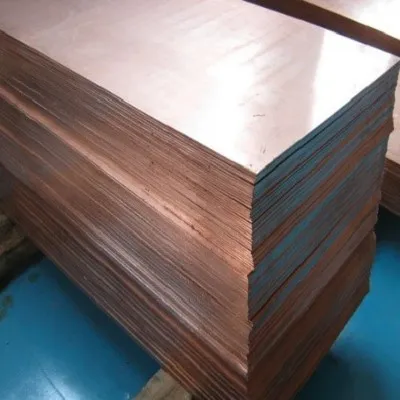

- Weigh the sample in air: First, you'll need to use a precise scale to measure the mass of the copper alloy sample. Make sure the scale is calibrated correctly for accurate results. Let's say the mass of the sample in air is (m_1).
- Weigh the sample in water: Next, you'll need to submerge the sample completely in water and measure its apparent mass. You can do this by suspending the sample from a thin wire or string and weighing it while it's submerged. The apparent mass in water is (m_2).
- Calculate the volume: The difference in mass ((m_1 - m_2)) is equal to the mass of the water displaced by the sample. Since the density of water ((\rho_{water})) is approximately (1\ g/cm^3) at room temperature, the volume of the sample ((V)) can be calculated using the formula (V=\frac{m_1 - m_2}{\rho_{water}}).
- Calculate the density: Now that you know the mass ((m_1)) and volume ((V)) of the sample, you can calculate the density ((\rho)) using the formula (\rho=\frac{m_1}{V}).
This method is relatively simple and doesn't require a lot of expensive equipment. However, it's important to make sure that the sample is completely dry before weighing it in air and that there are no air bubbles attached to the sample when it's submerged in water, as these can affect the accuracy of the measurement.
Pycnometer Method
A pycnometer is a special flask with a known volume. Here's how you can use it to measure the density of a copper alloy:
- Weigh the empty pycnometer: First, weigh the pycnometer when it's empty. Let the mass be (m_{pyc}).
- Weigh the pycnometer with the sample: Add the copper alloy sample to the pycnometer and weigh it again. Let the mass be (m_{pyc + sample}).
- Fill the pycnometer with a liquid: Fill the pycnometer with a liquid (usually a liquid that doesn't react with the copper alloy, like water or ethanol) until it's full. Weigh the pycnometer with the sample and the liquid. Let the mass be (m_{pyc + sample+liquid}).
- Weigh the pycnometer filled with only the liquid: Empty the pycnometer, clean it, and then fill it with the same liquid. Weigh it. Let the mass be (m_{pyc + liquid}).
- Calculate the density: The volume of the pycnometer ((V_{pyc})) is known. The volume of the sample ((V_{sample})) can be calculated as (V_{sample}=V_{pyc}-\frac{(m_{pyc + liquid}+m_{pyc + sample}-m_{pyc + sample+liquid})}{\rho_{liquid}}). The density of the sample ((\rho_{sample})) is then calculated as (\rho_{sample}=\frac{m_{pyc + sample}-m_{pyc}}{V_{sample}}).
The pycnometer method is more accurate than the Archimedes' principle method, especially for small samples. However, it requires more precise equipment and a bit more skill to perform.
X - ray Fluorescence (XRF) Analysis
XRF analysis is a non - destructive method that can be used to determine the elemental composition of a copper alloy. Once you know the elemental composition, you can calculate the theoretical density of the alloy based on the densities of the individual elements and their percentages in the alloy.
- Prepare the sample: Make sure the surface of the copper alloy sample is clean and smooth. You may need to polish the sample slightly to get accurate results.
- Perform the XRF analysis: Use an XRF analyzer to irradiate the sample with X - rays. The analyzer will detect the characteristic X - rays emitted by the elements in the sample and determine their concentrations.
- Calculate the density: Based on the elemental composition obtained from the XRF analysis, you can calculate the theoretical density of the alloy using the formula (\rho=\sum_{i = 1}^{n}x_i\rho_i), where (x_i) is the mass fraction of the (i) - th element and (\rho_i) is the density of the (i) - th element.
XRF analysis is a fast and accurate method, but it requires expensive equipment and trained operators.
Our Copper Alloy Products
At our company, we offer a wide range of copper alloy products. For example, we have Embossed Copper Sheet, which is not only aesthetically pleasing but also has good durability. Our C68700 Aluminum Brass Plate is known for its high strength and corrosion resistance, making it suitable for various industrial applications. And if you're looking for a solution to prevent moss on copper roofs, our Anti Moss Copper Roof Tape is a great option.
Contact Us for Purchasing
If you're interested in our copper alloy products or have any questions about density testing or copper alloys in general, don't hesitate to get in touch with us. We're always happy to help you with your purchasing decisions and provide you with all the information you need. Whether you're a small business or a large corporation, we can offer you high - quality copper alloy products at competitive prices.
References
- Callister, W. D., & Rethwisch, D. G. (2017). Materials Science and Engineering: An Introduction. Wiley.
- Shackelford, J. F. (2009). Introduction to Materials Science for Engineers. Pearson.